AI Marketing Automation for Agencies That Actually Ship
AI marketing automation for agencies: real deliverables, your approval, no markup on your Anthropic bill. By proposal, request one.
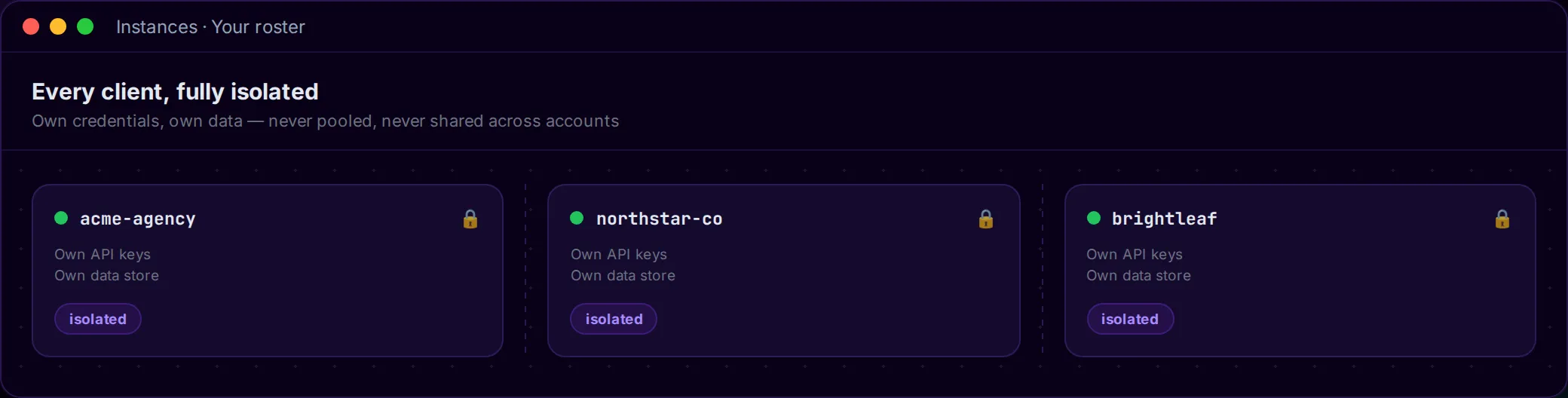
An AI stack that produces the audit, the draft, the report, the ad review for every client on your roster, then holds every output in a review queue until you approve it. Nothing gets published behind your back, and nothing reaches a client until you sign off.
One agency rebuilt 52 pages across a full client roster in 30 days without adding headcount. Clicks on a separate account climbed 61% in 28 days.
What “AI marketing automation for agencies” means when the buyer is an agency
Search the phrase and most of what ranks is built for a brand automating its own funnel: lead scoring, drip sequences, one pipeline. The agency job has a different shape.
An agency delivers client work across a roster. SEO audits on one account, a content pipeline on another, a Google Ads review on a third, monthly reports on all of them. The unit of measure is clients per person and margin per retainer, which is why we describe Orchestror as a multi-client AI automation platform rather than a single-funnel tool.
The software has to do more because of that. A brand tool touches one set of credentials and one voice. An agency platform keeps forty clients’ data apart, ships in forty different brand voices, and refuses to publish something wrong on an account you don’t own. The safety bar sits higher because the mistake lands on someone else’s site and gets you fired.
The economic trade is simple. You swap human delivery hours for platform cost plus provider cost across the roster, behind an approval gate you control.
The three problems generic automation tools don’t solve for agencies
Multi-client isolation
Every client runs on its own credentials, fully isolated. Data from one account never touches another. None of it gets pooled to train a model.
Each client gets a dedicated instance running around the clock inside one agency AI stack. When your ops lead asks how the thing handles forty accounts without leaking, the honest answer is that they were never sharing a box in the first place. Per-client credentials, per-client instance. Baked into the architecture from day one.
Approval gates before anything client-facing ships
Nothing publishes, changes, or sends externally without your explicit approval.
An entity drafts the audit or the article or the report. The output lands in a review queue. You read it. You mark it approved and only then does it go live. Reckless runs get blocked before execution, and every claim gets fact-checked afterward. Watch the approval gate run end to end.
The margin math
Generic tools chew your margin two ways. They price per seat, so client number forty is another login on the invoice. Or they bundle AI and data credits and mark up the spend, so your cost climbs with every account you add.
Orchestror runs compute on your own provider accounts at cost, with no markup and no reselling. The heavy data work happens in code instead of by burning tokens. That’s what keeps a weekly sweep across a large roster financially rational. The receipt on the token math sits a few sections below, for anyone who wants to pressure test the claim.

How Orchestror runs your roster, by task not by tool
Work gets organized by the marketing task instead of by which vendor a tool replaces. Each entity handles one job, stops at approval, and leaves a record in the client changelog. AI-run agency operations reduce to a task queue with a human at the gate.
SEO audits and opportunity sweeps. An entity pulls Search Console signal across the roster, flags striking-distance keywords, catches cannibalization, and ranks quick wins by real upside. You get opportunity sweeps across your roster on the cadence you set. One agency caught a cannibalization issue that had been sitting unnoticed for six months.
Content pipeline. Research, brief, draft, editor review, publish behind approval. The pipeline learns each client’s voice at onboarding so copy reads like the client and not like a template. One team went from three hours per blog post to four articles a week.
Paid-media audits. Entities review Google and Meta accounts for wasted spend, tracking breakage, and creative fatigue. On one account a tracking listener had been dead for 18 days, so the client was spending daily with zero conversions logged. The audit surfaced it. Inside 48 hours the account logged its first conversion at a $9.78 cost per acquisition.
Client reporting. Branded reports go out on schedule, every client, every month. No 40-page PDFs nobody reads. No copy-paste to-do lists. Month-end reporting stops eating the last week of the month.
Brand-voice modeling. Each client’s voice gets modeled once and reused, so juniors get leverage without the output flattening into house style.
If the setup is right, client number forty takes the same five minutes as client number one.
Proof: what agencies ship with it
- 52 pages rebuilt in 30 days, across a full client roster, one person driving.
- “It found the cannibalization we’d been missing for six months.”
- +61% clicks in 28 days on an account that had been flat for months.
- Same three-person team now runs three times the roster: eight sites to twenty-four.
You can run ten clients like one without dropping the quality bar or losing the margin you fought for.

What’s included at every size
There are no feature tiers. Whether you run eight clients or two hundred, you get the full set of entities on day one: SEO work, content, paid media, reporting, voice modeling, the approval gate, per-client isolation.
Most agency software hides the thing you actually need behind a higher plan. Here the capability doesn’t change with roster size, only your volume of runs does. Onboarding your fortieth client takes the same five minutes as your first because the platform doesn’t treat them any differently.
Your Anthropic bill stays yours. We never see it.
Where does your AI spend actually go? Most “AI for agencies” tools go quiet on that question.
Orchestror runs on two invoices, cleanly split. Your invoice from Anthropic covers model compute: your account, your credit, at cost. Our invoice covers the orchestration layer: platform, optimized skills, workflows, schedules, dedicated instance, onboarding, support. Each party bills for the layer it produces, and we never touch your AI or data spend.
Here’s the receipt on the compute claim. The optimized skills compute heavy data in code. A task a browser-style agent would burn roughly 200,000 tokens on runs in Orchestror for about 1,500 tokens. A weekly sweep across a large roster stays affordable because of that gap, and part of our fee gets paid back by the savings on your own Claude bill.
Any tool that bundles opaque AI credits or resells tokens is marking up the exact spend we hand back to you at cost. You get two invoices instead of one blended number, plus a receipt you can actually read.
Ask us straight whether your Anthropic bill stays separate and unmarked-up. Yes. Your account, your credit, and we never see the number.
How pricing scales (and what we never bill for)
The fee has a simple shape. A base platform fee covers your dedicated always-on instance. A run-band covers your volume of runs per month. It sits under a 6 to 12 month contract. Everything is included with no feature gates, and the two-invoice split above means we never bill for marked-up compute or resold data.
Think of it as swapping human delivery hours for platform cost plus provider cost. If a senior person spends half their month producing audits and reports across the roster, the fee replaces most of those hours and hands the margin back.
Compare the delivery hours you reclaim against the platform cost, per client. The number moves in your favor as the roster grows.
What does a weekly roster sweep actually cost? It sits inside your run-band. Runs aren’t billed per operation, so sweeping the whole roster every week doesn’t spike your invoice. Banding the runs is the whole point of the pricing shape. Full breakdown of how pricing scales on the pricing page.
Why we don’t do self-serve (and why that’s for you)
There is no free trial and no online signup. The gate is deliberate and it works in your favor.
Value here compounds per client: the Second Brain, the changelog, the workflows that stack up as each account runs. Real switching cost. It protects the investment you’re about to make. We provision a dedicated instance per client instead of dropping you into a shared login next to a hundred tourists kicking the tires.
Access works in four steps.
- Request a proposal.
- A short discovery call covering active clients, channels per client, cadence, content pieces per month, ad accounts.
- A number within 48 hours.
- A dedicated instance provisioned when you close.
A closed door reads as a signal. An outfit confident in the work doesn’t need to give it away to fill a funnel, so we say “request a proposal” instead of “book a demo.” To be clear about who buys and who logs in: your agency buys, your agency uses. Your own clients never log in.
Explore the AI marketing automation stack
Each piece below does one job. See how they fit together:
- 12 marketing tasks you can automate with AI, ranked by hours saved per client.
- How agencies automate marketing tasks with AI, the rollout playbook.
- Agency workflow automation with AI, from intake to report.
- AI marketing tools for agencies, the six categories and where they overlap.
- AI marketing software for agencies, how to choose by job-to-be-done.
- The best AI marketing automation tools for agencies, tested and compared.
- Running SEO specifically? See AI SEO automation for the audit-to-publish loop.
Request a proposal
You can carry three times the roster on the same team without dropping the quality bar or the margin. Entities do the delivery work. You approve what goes live, and your Anthropic bill sits on your own account.
Request a proposal. A five-question discovery call, a number within 48 hours, and a dedicated instance provisioned when you close.
Not ready to talk numbers? See how it works first.
Every account on the roster runs behind one ghost sigil, with you at the gate.
Frequently asked questions
How is this different from generic marketing automation tools?
Generic tools automate one brand’s funnel. Orchestror is AI marketing automation software for agencies delivering client work across a whole roster. Entities produce real deliverables and stop at your approval before anything ships.
What’s the best AI marketing automation for agencies right now?
Most “best AI marketing automation for agencies” roundups score tools built to run one company’s funnel, not a client roster. None of them test for the three things that actually matter here: per-client isolation, an approval gate before anything ships, and no markup on your AI spend. Score any shortlist on those three before you compare price.
How does the approval gate actually work?
An entity produces a draft. It lands in a review queue. You approve it and it ships. Nothing that publishes, changes, or sends externally goes live without you signing off.
Is client data isolated across accounts?
Yes. Every client has its own credentials and its own dedicated instance. Data never crosses accounts and never gets pooled to train a model.
Won’t AI compute get expensive at 40 clients?
The heavy work runs in code instead of by burning tokens, and the compute runs on your own accounts at cost. A weekly roster sweep costs a fraction of what agent-style tools spend on a single account.
What does it actually cost?
A base platform fee plus a run-band, under a 6 to 12 month contract. We never bill for marked-up compute or resold data.
Can we white-label reports to our clients?
Yes. Branded reports go out on the schedule you set.
What if a scheduled run fails?
It retries, and every action leaves an audit trail so you can see who did what and when.
Do you resell AI credits or tokens?
No. Two invoices: yours to Anthropic for compute, at cost, on your account, and ours to you for the orchestration layer. No markup, no reselling. The optimized skills compute heavy data in code, roughly 1,500 tokens against the 200,000 a browser-style agent would burn, so part of our fee is covered by the savings on your own Claude bill.
Why can’t I sign up online?
Access is by proposal on purpose. Every client gets a dedicated instance provisioned per engagement instead of a shared login. You take a short discovery call, get a number within 48 hours, and your instance stands up on close. We don’t sell to tourists. The closed door is the filter.