How Orchestror Runs a Full AI SEO Site Audit — From One Sentence
An AI SEO site audit from one sentence — five specialists run in parallel, findings merge into one scorecard and a ranked fix list you sign off before anything ships.
Most audits start with a spreadsheet and end with a lost afternoon. You open the crawler,
then the speed tool, then the backlink checker, then the on-page grader. By the time
you’ve pasted it all into one place, half the numbers are already stale. This post shows
the other way: one conversation with one entity, and a finished, prioritized AI SEO site
audit comes back. Here’s what that looks like from your side of the screen.
This is part one of Talking to your Ghost team — a series that opens the hood on each
entity in Orchestror and shows you the conversation that drives it.
The ask — what you actually type
You open a chat with the site-audit entity and type something a human would say:
“Run a full SEO audit on orchestror.com and tell me the three things costing us the
most traffic right now.”
That’s it. No config screen, no checkbox forest. You reach for this conversation before a
client kickoff, ahead of a quarterly review, or the moment rankings wobble and someone
asks “what changed?” — the moments where you’d otherwise burn two hours stitching five
tools together by hand.
What comes back
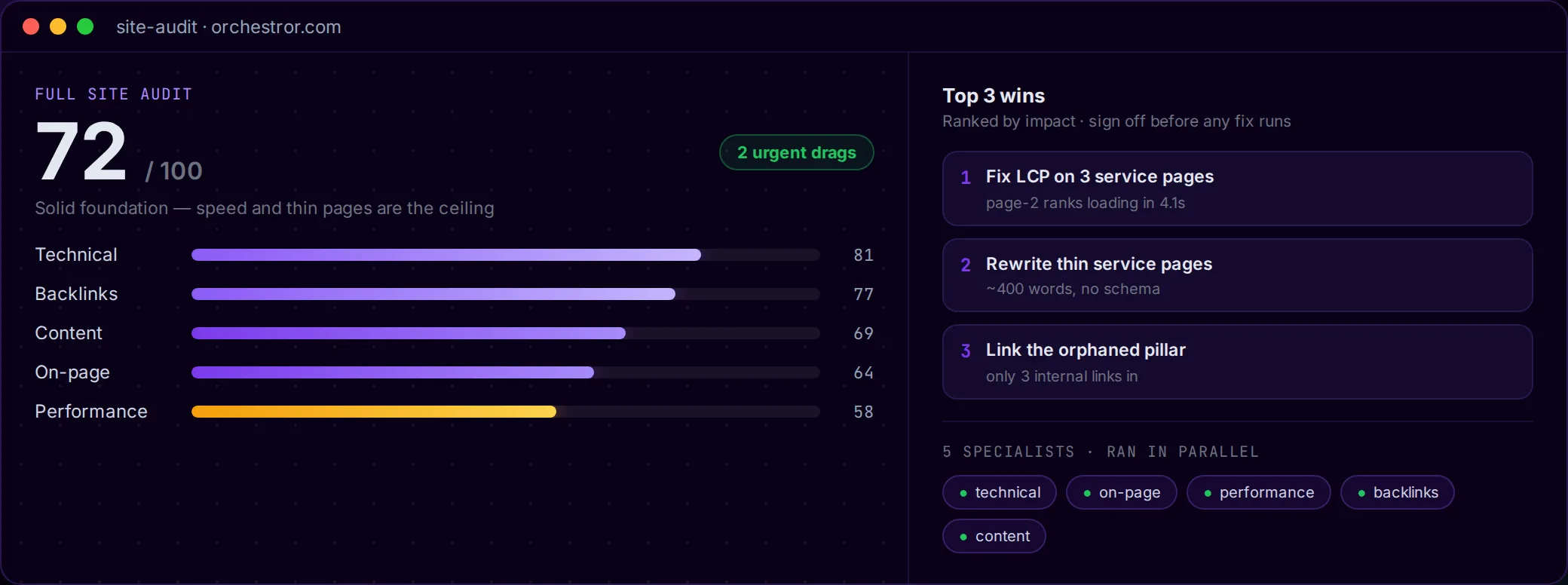
A single, unified scorecard, not five disconnected exports:
| Area | Score | Headline |
|---|---|---|
| Overall health | 72 / 100 | Solid foundation, two urgent drags |
| Technical | 81 | Clean crawl, minor redirect chains |
| On-page | 64 | Thin service pages, weak title patterns |
| Performance | 58 | Slow LCP on the money pages |
| Backlinks | 77 | Healthy profile, a few toxic anchors |
| Content | 69 | Depth gaps against the pillar |
Under it, the part you actually act on — the three biggest wins, ranked by impact:
- Fix LCP on the top three service pages. They rank on page two and load in 4.1s;
speed is the ceiling. - Rewrite the thin service pages. ~400 words each, no schema, losing to deeper
competitors. - Link the orphaned pillar. Your best asset has three internal links pointing to it.
Delivered as a branded HTML report you can hand to a client as-is. Representative numbers
here; your real run pulls your real pages.
Behind the conversation — who it calls, and why
You asked one entity. That entity quietly convenes a room of specialists and runs them
at the same time, each on the slice it’s best at:
- technical-auditor — why: crawlability, indexation, redirects, structured data. The
“can search engines even read this?” layer. - on-page-auditor — why: titles, meta, headings, alt text. The per-page fundamentals.
- performance-auditor — why: Core Web Vitals and load speed, the silent ranking tax.
- backlink-analyst — why: link profile, toxic links, anchor health — your authority.
- content-quality-auditor — why: depth, experience signals, freshness. The “is this
actually the best page on the topic?” read.
Each specialist reaches for its own tools underneath: a crawler here, a search-data
lookup there, a speed test, a backlink index. You never manage any of that. Five toolbars’
worth of work lands as one answer you can read in a minute.
How the answer gets richer
The fan-out isn’t the clever part. The merge is. Five independent reads become one ranked
plan. Three moves get you there:
- Independent findings. Each specialist reports without the others’ bias, so nothing
gets rationalized away. - Cross-referenced weighting. site-audit lines the findings up against each other.
When a performance flag and a content flag land on the same page, that page gets
promoted: a slow, thin money page outranks a fast, thin blog post every time. - Prioritized action list. You get a short list of what moves the needle first,
so you act on it instead of wading through 40 pages of “here’s everything.”
Two things make it safe to trust. Nothing is changed: this is a diagnosis you sign off
before any fix ever runs, so a wrong call can’t quietly ship to a client’s site. And every
audit is isolated per client, so one account’s data never bleeds into another’s.
When to reach for it
Kickoffs, quarterly reviews, sudden ranking drops, or a prospect who wants a teardown on
the first call. A machine auditing faster isn’t really the point. What matters is that the
same team can now run ten client audits in the time one used to take, and walk into every meeting with a
ranked plan instead of a pile of tabs. Your roster grows; your afternoons come back.
Try it on your next client. Open a chat with your site-audit entity and paste the one
sentence from the top: “Run a full SEO audit on [yourclient].com and tell me the three
things costing us the most traffic.” You’ll have a ranked plan before the coffee’s cold —
and nothing touches the site until you say so.
Next in the series: the content-pipeline conversation — one sentence in, a
research-backed, edited, optimized article out, waiting for your approval before it
publishes.