SEO AI Agents That Run the Whole Workflow
SEO AI agents coordinate a team of specialists across your full workflow. Live data, ranked actions, real output beyond another dashboard.
SEO AI Agents: How to Automate Your Entire SEO Workflow (Not Just the Data)
Everyone’s celebrating that AI made SEO data cheap. That’s the wrong thing to be excited about. Ahrefs and SEMrush build their numbers from a scraped index that gets cached, sometimes for weeks. So when you pipe those numbers into an AI model, you’re asking it to reason on last month’s internet. The real shift with SEO AI agents is that they pull data live, at the moment they need it, and put a coordinated team of specialists to work on it right away.
That team is the bigger story, and it isn’t about replacing anyone. The expensive part of SEO was never the data. It was the hours: running the audit, reading the report, building the brief, writing the draft, editing it, publishing it, then doing it all again next month. SEO AI agents take that repetitive work off your team’s plate (data pulls, first-pass audits, first drafts) so the humans can spend their time on strategy, judgment calls, and raising the quality bar on what actually ships. Same team. A lot more gets out the door.
Think of it less as renting a smarter dashboard and more as handing your team a second crew of specialists who quietly take the grunt work off their desk.

Caption: The orchestrated model — specialist agents fan out for a parallel audit, hand off to a content pipeline, pass through a human approval gate, then publish.
The real SEO cost was never the tool subscription — it was the manual labor
Start with the bill you already pay. A serious SEO suite runs $130–$250 a month. Ahrefs’ entry Lite plan sits at $129/mo, and its Standard tier jumps to $249/mo. SEMrush’s SEO suite starts at $165/mo, with its Pro+ and Advanced tiers climbing to $248/mo and $455/mo, before you add AI-visibility modules or extra datasets, which almost always cost more on top.
Here’s the awkward part: that subscription solves maybe 10% of your actual SEO problem. It shows you the data. It doesn’t act on it.
You still open the crawl report and decide what matters. You still cross-reference rankings with traffic to find the real opportunities. You still write the brief, hand it to a writer, review the draft, fix the on-page elements, hit publish. Every one of those steps is human hours — the resource actually in short supply at any agency.
So when people say “AI made SEO data cheap,” they’re celebrating a discount on the cheapest 10%. The other 90% is the operational work. That’s where SEO AI agents change the economics.
What is an SEO AI agent, really?
An SEO AI agent is software that can take a goal (“audit this site,” “find content opportunities,” “write and publish this article”) and execute the multi-step work to get there. It pulls the data, makes decisions along the way, and produces an output, all without you steering every click.
That’s the promise. The reality depends heavily on how many agents you have and whether they’re coordinated. This is where most of the market gets confused.
Single-agent hacks vs. orchestrated multi-agent systems
You can rig up a single AI agent today. Point a chatbot or a coding agent at a data connection and it’ll fetch keywords or summarize a crawl. Works fine for one task at a time.
The trouble is a lone agent is a generalist doing everything in sequence. Ask it to audit a site, then research keywords, then write a brief, and it grinds through them in a line. Context leaks between steps. It doesn’t have real specialization in any of them — a Swiss Army knife pretending to be a workshop.
An orchestrated multi-agent system is the workshop. Instead of one agent switching hats, you have a multi-agent SEO platform where a technical auditor, a keyword analyst, a content strategist, a writer, an editor, and a publisher each own their lane, and a coordinator runs them together. That’s the difference between “I automated a task” and “I automated the workflow.”
The tasks a real SEO agent should own
If you’re evaluating any AI SEO agent for agencies, hold it to the full chain, not one clever trick:
- Audit — crawl, technical health, on-page, backlinks, performance.
- Research — keyword discovery, opportunity gaps, competitor and SERP analysis.
- Strategy — turn findings into prioritized briefs with intent and target keywords.
- Content — draft, edit, and optimize against the brief.
- Publish — push to the CMS with structured data and internal links intact.
Anything that covers only one link in that chain isn’t automating SEO. It’s automating a lookup.
Why one AI agent isn’t enough (the bottleneck problem)
Say you go all-in on a single powerful agent. You’ll run into three walls fairly quickly.
The first: everything happens in sequence. One agent does one thing at a time, so a full site audit covering technical, backlinks, content quality, and performance becomes a slow line instead of four specialists working at once. What could take minutes in parallel takes an afternoon in series.
The second: context leaks. Push enough tasks through a single conversation and earlier findings get crowded out. The keyword insight from step one is already fuzzy by the time the agent is writing the brief in step six. Specialists sidestep this because each carries only its own focused context.
The third: generalists don’t specialize. Technical SEO, content strategy, and backlink analysis are genuinely different skill sets, and one agent trying to hold all three ends up mediocre at each. Dedicated agents — one tuned for crawlability and indexation, another for opportunity analysis, another for editorial quality — do the same jobs at a higher level.
The fix is the same pattern that makes human teams work: parallel specialists pointed at one goal. Run the technical auditor, backlink analyst, content auditor, and performance auditor at the same time, then merge their findings. That’s an agentic SEO workflow, and it’s structurally impossible with a single agent.
Want to see specialists working in parallel instead of a chatbot grinding one task at a time? Take a look at the multi-agent dashboard.
The agentic SEO workflow, step by step
Here’s what “automate SEO with AI” looks like when it’s built as a team instead of a single bot.
Autonomous audits at scale
A coordinator dispatches several audit agents at once. One checks crawlability, indexation, and site architecture. Another analyzes the backlink profile and toxic links. Another grades content depth and E-E-A-T signals. Another measures Core Web Vitals. They run in parallel, then a report generator unifies everything into one prioritized document. That’s what AI SEO audit automation actually looks like — not a single scan, but a coordinated inspection.
Keyword & opportunity discovery
A dedicated analyst agent pulls fresh data from your connected SEO sources and search-performance data (not a cached snapshot from last month’s crawl) to surface striking-distance keywords, cannibalization, and content gaps. It ranks them by real upside instead of raw volume. You get a short list of what to work on instead of a spreadsheet to sift through.
Content briefs, drafts, editing — as a pipeline
The team model really shows its value here. A content strategist turns opportunities into a brief with intent, target keywords, and outline. A writer produces the draft. An editor reviews it against the brief for accuracy and quality. An optimizer handles on-page structure and internal links. Each hands off to the next. That’s an autonomous SEO content pipeline, not one agent trying to play all four roles at once.
Human approval gates before publishing (HITL)
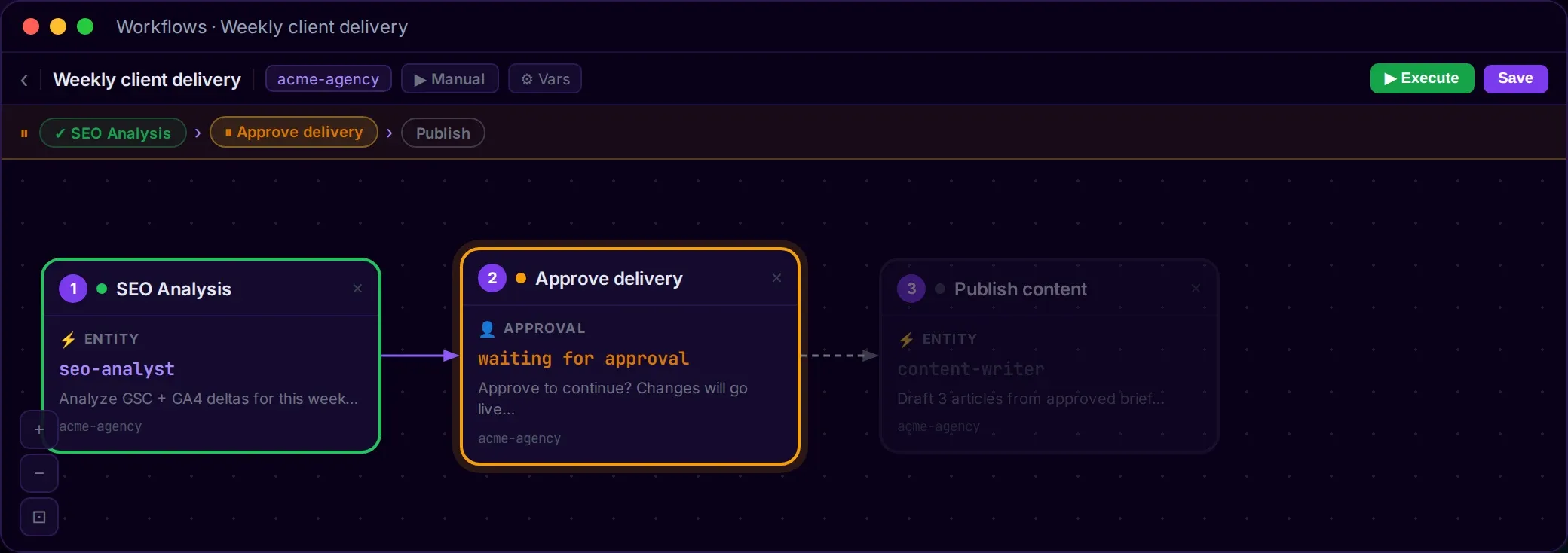
Automation without oversight is how bad content ends up live. A mature agentic SEO workflow includes human-in-the-loop gates. The pipeline pauses before anything publishes, sends you an approval link, and waits. You stay the editor-in-chief. The agents do the labor; you keep the final say.
Scheduled monitoring that reruns itself
The workflow doesn’t need re-launching, and that’s the best part. Put it on a schedule (a weekly technical check, a monthly opportunity scan, a rankings watch) and it reruns on its own, notifying you only when something needs your attention. Your SEO operation keeps running while you sleep and pings you when it matters.
How Orchestror runs this out of the box
Everything above is what Orchestror ships as a product, not a concept you have to assemble yourself.
A multi-agent dashboard, not a plugin. You delegate to a roster of specialist agents — technical auditor, SEO analyst, content strategist, writer, editor, optimizer, backlink analyst, and more. No plugin to install, no API keys to hand-wire into a coding tool, no single-agent bottleneck. You describe the outcome; the right specialist takes it from there.
Workflows with parallel steps and approval gates. Chain agents into pipelines that run specialists at the same time, pause at human approval gates before publishing, and send Slack notifications when a step finishes or needs you. These are the automated SEO workflows that turn one-off tasks into a repeatable operation.
Schedules for recurring monitoring. Set a workflow to run on a cron schedule — recurring audits, keyword scans, rankings checks — and it executes on its own and reports back. Set it up once and it keeps running.
Pay-as-you-go, bring-your-own-keys economics. Instead of a fixed suite fee plus dataset upcharges, Orchestror runs on pay-as-you-go economics with your own model keys (Claude, OpenAI) and data connections. You pay for the work you actually run, no hidden AI-dataset surcharge stacked on top of a subscription you barely use.
Orchestror is built for agencies and marketers, so everything speaks to you, the operator. You run the team on behalf of your clients; the platform stays yours.
SEO AI agents vs. Ahrefs & SEMrush: which do you actually need?
This isn’t quite apples to apples, and that’s the point. The incumbents are data viewers; agent platforms are work doers. You might even keep a data suite and run agents on top of it — just be honest about what each one is for.

Caption: The core distinction — a dashboard hands you data to act on; an agent team does the acting.
| Ahrefs / SEMrush | SEO AI agents (Orchestror) | |
|---|---|---|
| Primary job | Show you data | Do the work |
| Data freshness | Scraped index, cached (sometimes for weeks) | Pulled live, at the moment it’s used |
| Audits | You read the report | Specialists run it in parallel and prioritize |
| Content | You write it | Brief → draft → edit → publish pipeline |
| Runs on a schedule | You log in and check | Reruns itself, notifies you |
| Human approval | N/A | Built-in HITL gates before publishing |
| Pricing | Fixed suite + dataset upcharges | Pay-as-you-go, bring your own keys |
| What you supply | Your time to operate it | The goal and the final approval |
If your problem is “I need to see more data,” a suite is fine. If your problem is closer to “I don’t have enough hours to act on the data I already have,” that’s the Ahrefs / SEMrush alternative you’ve actually been looking for — not a cheaper dashboard, but a team that operates one.
Getting started with agentic SEO
You don’t need to rebuild your stack to try this. Start narrow and let the results argue for themselves:
- Pick one recurring pain — usually the monthly technical audit or the content-brief bottleneck.
- Run it as an automated workflow instead of doing it by hand once.
- Keep the approval gate on so nothing publishes without your sign-off while you build trust in the output.
- Put the winner on a schedule so it reruns without you.
- Expand from there — add the content pipeline, then opportunity monitoring, one workflow at a time.
Within a few cycles the pattern flips: you stop operating dashboards and start reviewing finished work. See what that looks like in practice, and read the full guide to automating marketing tasks with AI when you’re ready to go deeper.
For the full mechanics of how these agents run together in production, see AI SEO automation.
Conclusion
The excitement about cheap SEO data is aimed at the wrong target. Cheap data is table stakes now — everyone has it, and most of it is still weeks stale by the time it reaches an AI model. The real moat in 2026 is orchestration: a coordinated team of specialized SEO AI agents, working from live data instead of a cached index, that audits, researches, strategizes, writes, and publishes as one system — in parallel, on a schedule, with you holding the approval button.
A single chatbot can fetch a keyword list. A multi-agent platform runs your operation.
Stop paying for dashboards you have to operate by hand. Run a whole SEO team on Orchestror — start with your first automated audit.